DECISION GUIDE
What to check before deciding
Can Tripo AI be used commercially?
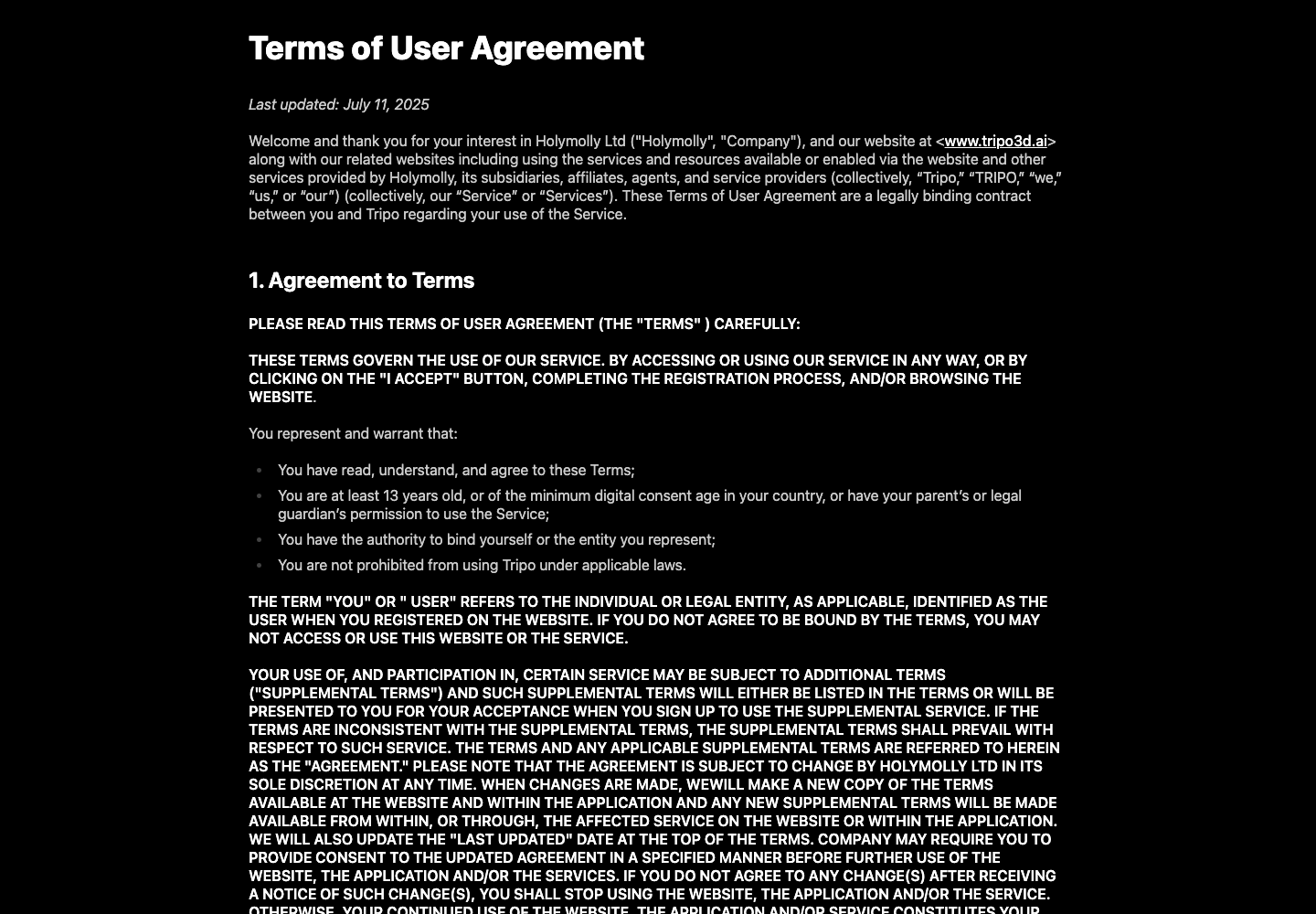
The current Tripo Terms allow lawful commercial and non-commercial use of outputs subject to the agreement. That permission is contractual access to use the service output; it is not a guarantee that an input was authorized, an output is original or a particular sale is lawful.
- Check the Terms that apply when the asset is created.
- Keep the account plan and creation date with the asset record.
- Separate service permission from third-party rights clearance.
What rights do free Tripo users receive?
Under the current Terms, free users grant Tripo broad rights in submitted inputs and generated outputs. Do not infer exclusive ownership or confidentiality from a free workflow, and do not upload client-confidential or rights-sensitive material without checking the active settings and contract.
- Archive the applicable Terms and privacy setting.
- Avoid confidential references in public workflows.
- Upgrade before production only after confirming the paid terms solve the actual rights need.
What rights do paid Tripo users receive, and is their data used for training?
The current Terms generally give paid users broad rights in their inputs and outputs, subject to compliance and the license needed for Tripo to provide the service. They also state paid-user inputs and outputs are not used as training data. This remains subject to the current contract and account status.
- Confirm the subscription was active at creation time.
- Retain invoices or account records with important assets.
- Review enterprise or client terms separately where applicable.
Are Tripo AI outputs exclusive, and does Tripo guarantee non-infringement?
Tripo disclaims warranties of accuracy, completeness, merchantability, fitness and non-infringement. Its Terms also warn that outputs may be similar or identical to other users' outputs. Treat every asset as a candidate requiring review, not exclusive commissioned artwork.
Outputs may not be unique or non-infringing
- Run visual and trademark similarity checks for important assets.
- Escalate recognizable characters, logos and trade dress.
- Avoid promising clients exclusivity without a defensible review process.
You must have rights to the input
Users are responsible for having the rights and permissions needed for uploaded images, text, models, logos, characters and likenesses. Owning the generated file does not cure an unauthorized reference.
- Use original, licensed or clearly permitted source material.
- Record licenses, releases and attribution duties.
- Do not assume public availability means commercial permission.
What restrictions, privacy and storage rules apply?
Outputs and the service cannot be used unlawfully or to violate third-party intellectual property. The current Terms also restrict using outputs to create models or services that directly compete with Holymolly or Tripo. A developer building an adjacent 3D product should review this clause before integration.
Restricted and competing uses
- Map the product purpose against current restricted-use language.
- Do not rely on a marketing summary for a borderline use.
- Seek qualified advice when the business itself could be considered competitive.
Privacy, storage and public visibility
Tripo does not guarantee storage, and users remain responsible for access and privacy settings. Public content may be retained. Download source records and final assets you need, and avoid treating the service as the only archive.
- Confirm whether each model is public or private.
- Keep local copies and project metadata.
- Define deletion and client-access procedures outside the service.
How should commercial rights be reviewed for production work?
For a game, confirm input rights, output review, engine suitability and plan status. For physical products, add trademark, safety and product-specific review. For client work, document who supplies references, who approves the output and what rights are actually transferred.
Games, printing and client work
- Games: license record plus technical asset gate.
- Printing: rights review plus physical and safety checks.
- Client delivery: written scope, approval and limitations.
When legal review is proportionate
Seek qualified legal advice when an asset uses a recognizable person, brand, copyrighted character or client-owned confidential material; when exclusivity is promised; when the product competes with Tripo; or when a high-value launch depends on the rights conclusion.
- Bring the current Terms, source inputs and account plan.
- Describe the exact market, region and distribution.
- Ask about the asset, not AI use in the abstract.
Final Tripo AI commercial use checklist
Proceed only when the input is authorized, the current plan and Terms fit the project, the output has passed similarity and technical review, and the team can document the decision. Stop when a rights gap cannot be resolved or the contract conflicts with the intended product.
- Source license recorded
- Plan and Terms archived
- Output reviewed
- Restrictions checked
- Human approval recorded