DECISION GUIDE
What to check before deciding
How does the Tripo AI API work, and who should use it?
Automate only after the same representative asset can move through Studio and downstream validation. The API removes manual submission, but it does not remove uncertain generation, cleanup, rights review or destination-specific checks.
- Good fit: queued batch jobs and creator tools that tolerate variable completion time.
- Poor fit: instant deterministic output or safety-critical geometry.
- Go first with one narrow capability rather than the full product surface.
How is the Tripo AI API authenticated?
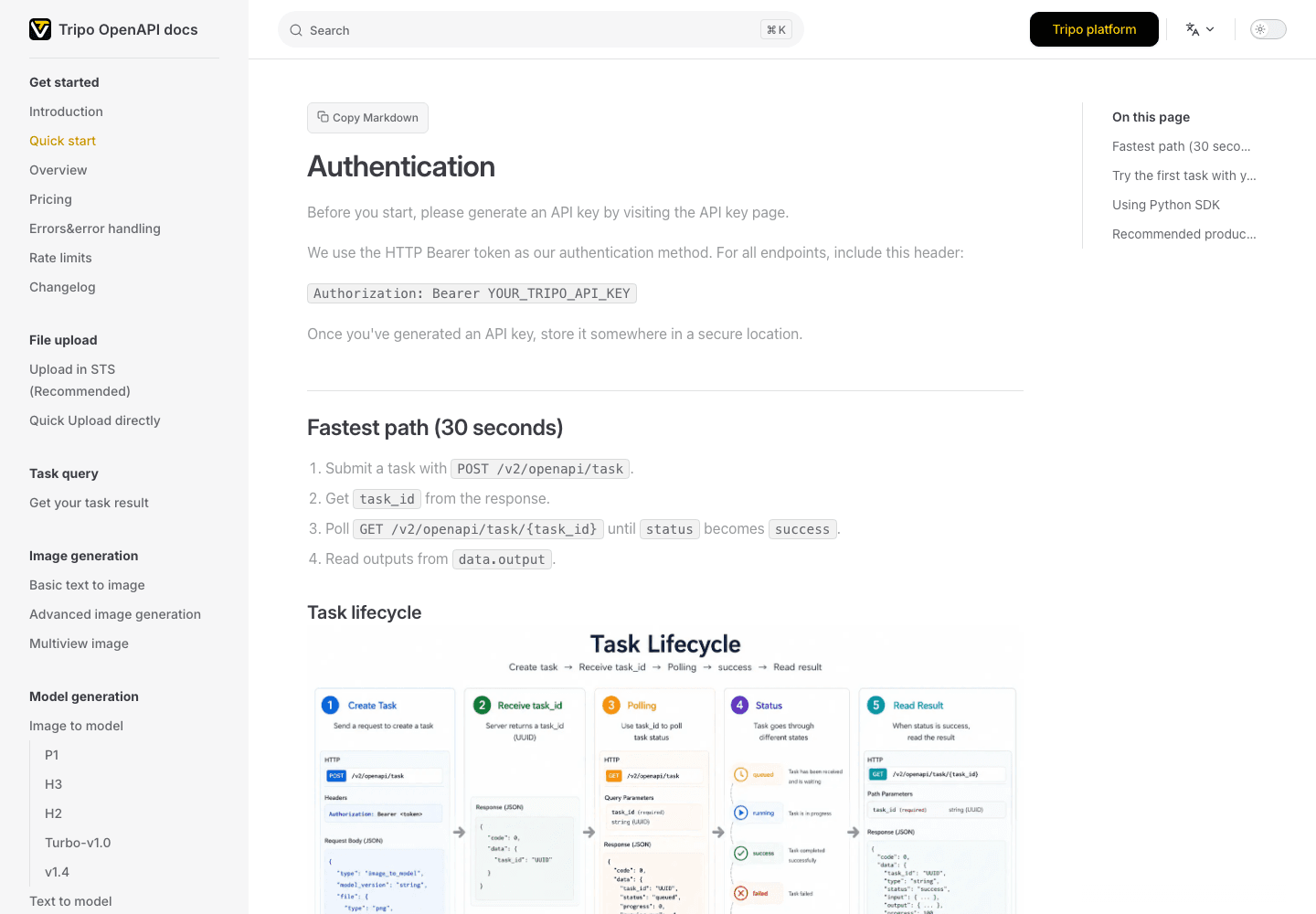
Official documentation uses the HTTP header `Authorization: Bearer YOUR_TRIPO_API_KEY`. Create keys in the Tripo developer platform, keep them in a server-side secret store and never expose them in client JavaScript, public repositories, screenshots or support messages.
- Use separate keys by environment when the account supports it.
- Rotate a key immediately after exposure.
- Restrict internal access and log use without logging the secret.
Should a new integration use V2 or V3?
The documentation currently has a version boundary. Legacy material describes a universal V2 task endpoint, while V3 introduces dedicated capability endpoints, moves fields under `input` and standardizes response names. Existing keys work across both versions and V2 and V3 may run in parallel.
- Do not combine examples from different versions in one client.
- Pin the endpoint family and response contract in code.
- Migrate and test one capability at a time, as the official guide recommends.
How do Tripo API tasks and polling work?
A normal Tripo AI API flow submits a task, receives a `task_id`, polls the task-result endpoint and downloads the completed artifact. Query the result with the same API key that created the task, and store task state so a worker restart does not orphan paid work.
- Persist the task ID before returning control to the user.
- Use bounded polling with a timeout and terminal failure states.
- Make callbacks, retries and download jobs idempotent.
What are the Tripo API credit and concurrency limits?
The API is prepaid and credit based. Different generation, refinement and animation options can consume different amounts, so link budgets to the live pricing table instead of copying a volatile list. Current limits are concurrency buckets, not a separate unlimited queue for every raw task type.
- Current primary text, image and multiview group: 5 concurrent tasks.
- Other text, image and multiview versions: 10; refine: 5.
- Multiview image generation or edit: 1; image uploads: 10 QPS.
- Confirm live limits before setting worker counts.
How long do Tripo API download links last?
Official task documentation says model and image download URLs expire after five minutes by default. A successful task is therefore not a durable asset store. Download immediately to storage you control, verify the response and retain the task-to-artifact mapping.
- Do not hand a temporary URL to a delayed background job.
- Check content type, size and checksum where practical.
- Apply your own retention, access and deletion policy.
How should failures, formats and SDK choices be handled?
Use exponential backoff with jitter for 429 responses and respect concurrency rather than retrying in a tight loop. Official responses include `X-Tripo-Trace-ID`; log it with the task ID, endpoint version and internal request ID so failed jobs can be investigated.
Handle 429s, failures and trace IDs
- Separate retryable transport failures from terminal task failures.
- Cap retries and surface a recoverable user state.
- Do not depend on undocumented output fields for critical logic.
Formats still need downstream validation
Official conversion documentation covers GLTF, USDZ, FBX, OBJ, STL and 3MF with format-specific restrictions. Format availability does not prove that scale, topology, UVs, textures, rigs or printability will survive the destination workflow.
- Validate one exported sample in the real application.
- Record conversion settings and model version.
- Reject output that misses the destination quality gate.
Python SDK or direct HTTP
The official `tripo3d` Python package supports synchronous and asynchronous workflows. Use it when its abstractions match the pinned API version; choose direct HTTP when another stack, stricter request control or a smaller dependency surface matters.
- Install with `pip install tripo3d`.
- Review the official VAST-AI-Research/tripo-python-sdk repository.
- Wrap either choice behind your own job boundary and tests.
Go or no-go integration decision
Proceed when the product can queue work, tolerate variable results, store outputs immediately and absorb retries within a measured credit budget. Stop when latency, deterministic geometry, contractual rights or operational limits conflict with the product promise.
- Run one authenticated non-production task before estimating cost.
- Test a forced timeout, a 429 path and an expired download URL.
- Review current docs and terms before production launch.